
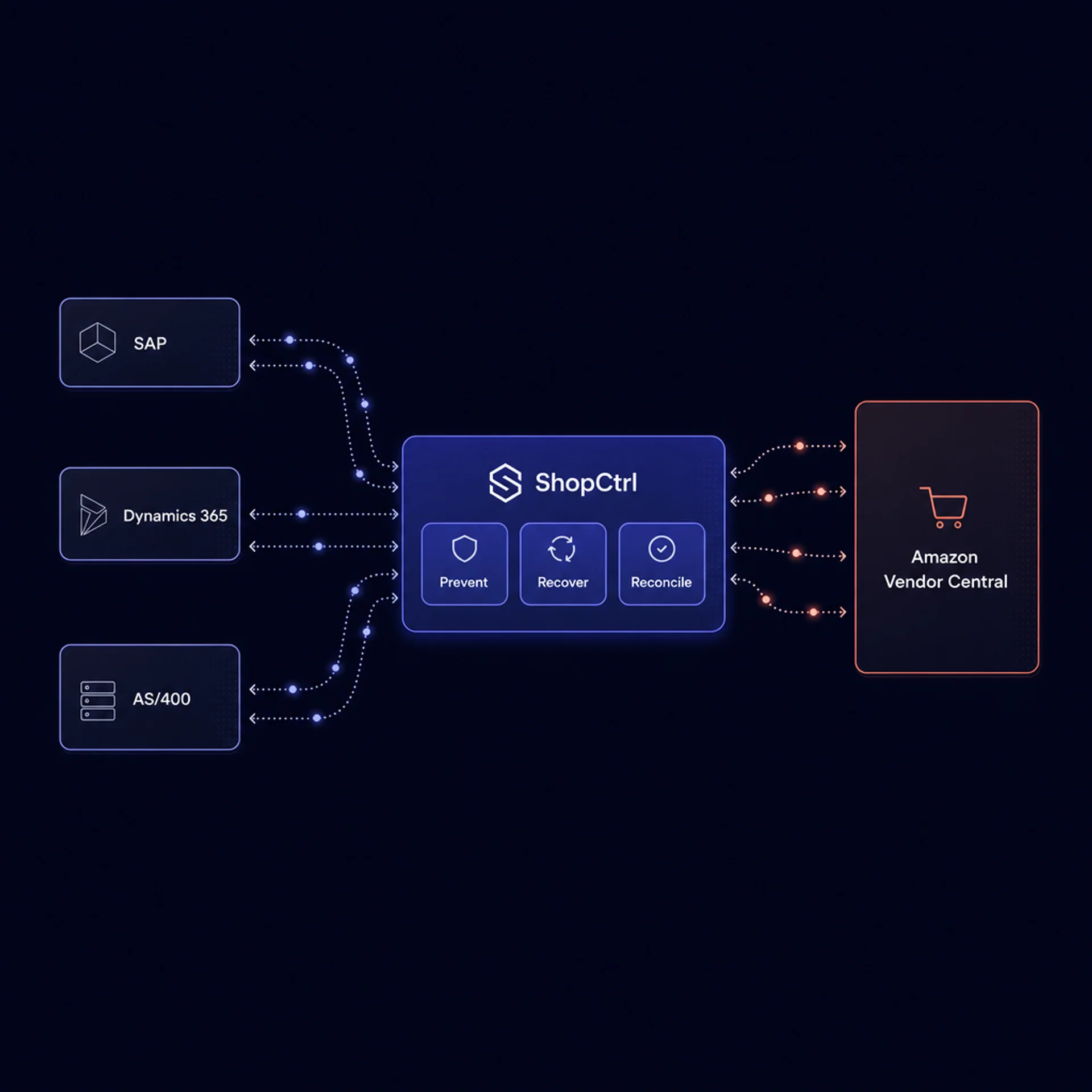
Margin infrastructure for Amazon Vendor Central is the permanent layer between Amazon and the ERP that validates every purchase order, recovers every deduction, and reconciles every transaction to the system of record. It is the discipline that turns the most chaotic channel on the enterprise P&L into the most controlled.
Where a recovery tool or agency files disputes after the fact, margin infrastructure prevents the loss at source and keeps Amazon permanently reconciled to the ledger, so the channel stops leaking margin and starts behaving like every other governed part of the business.
Table of Contents
What is margin infrastructure?
Margin infrastructure is a category of system, not a feature. It describes the layer a manufacturer puts between Amazon Vendor Central and its ERP to make the channel financially controlled: every transaction validated on the way in, every deduction recovered inside its window, and every euro reconciled to the system of record.
The word “infrastructure” is deliberate. Infrastructure is permanent, runs in the background, and is judged by what it prevents rather than what it produces. A recovery agency is a service you hire after the damage is done.
Margin infrastructure is plumbing: once it is in place, the chargebacks that used to recur are caught upstream, the deductions that used to expire are filed automatically, and the reconciliation that used to take a week of spreadsheets happens continuously.
That is the distinction that defines the category. Tools and agencies operate inside Amazon Vendor Central and look backward. Margin infrastructure operates between Amazon and the ERP and looks forward.
Why Amazon Vendor Central needs margin infrastructure
Amazon is, for many manufacturers, among the largest customers by revenue and the only one without a system of record. Retail flows through EDI. Distribution reconciles through the ERP. Direct-to-consumer runs on
a commerce platform. Amazon 1P runs on spreadsheets, agencies and the memory of one or two people. That gap has a financial name: margin leakage. As a benchmark, 3% to 11% of gross 1P revenue leaks back to Amazon every year through chargebacks, shortages and deductions. On a €200M program that is €6M to €22M.
The leak persists because the channel is unmeasured: fewer than one in three finance teams can state their net Amazon cost within five minutes, and roughly 80% reconcile Amazon by hand after the period closes.
Amazon is the largest channel in the enterprise. And the only one running on spreadsheets.
Margin infrastructure exists to close that gap. It is the answer to a question recovery cannot answer: how do you make Amazon as controlled, as forecastable and as audit-ready as every other channel on the P&L?
The three layers of margin infrastructure
Margin infrastructure is built from three layers that work as one system. Each is necessary; none is sufficient alone. Together they move a vendor from reacting to the channel to governing it.
Layer 1 — Integration (Amazon Vendor Central ERP integration)
The foundation is a live, bidirectional Amazon Vendor Central ERP integration. A one-way CSV export is a snapshot: the moment it is taken, Amazon and the ERP begin to drift, and the unreconciled balance reappears every period. True integration is bidirectional and ERP-native, so purchase orders, invoices, remittances and disputes flow both ways and the two systems stay in agreement continuously.
This is the layer that makes the rest possible. Without a real Amazon Vendor Central ERP integration, every other control is performed against stale data, by hand, after the fact. The target is the same kind of native
connection the channel would have to an ERP such as SAP or Microsoft Dynamics.
Layer 2 — Intelligence (validate, recover, reconcile)
On top of integration sits the intelligence layer: the logic that validates every purchase order against Amazon’s requirements before it ships, catches the ASN, routing and labelling defects that become chargebacks, files recoverable shortages and deductions inside their windows, and reconciles every remittance line to the purchase order and invoice.
This is where prevention replaces firefighting. Validation at source stops defects becoming penalties; automated recovery captures what remains before the window closes; line-level reconciliation turns the deduction reserve from an estimate into a number built from data.
Layer 3 — Governance (board-grade control)
The third layer is governance: the reporting and audit trail that make the channel defensible. For any deduction,finance can produce the purchase order, the ASN, the dispute and the outcome on demand. Amazon margin
becomes a board-grade metric, reported by period, that the CFO canstand behind in an audit.
Tools recover. Infrastructure prevents.
Margin infrastructure vs revenue recovery
The most common confusion is between margin infrastructure and revenue recovery. They are not two names for the same thing; they sit at different points in the process and produce different outcomes.
Revenue recovery is backward-looking and partial. An agency or internal team files disputes after deductions land, recovers a fraction of one period’s loss, and changes nothing about the process that produced it. The same chargebacks recur next period; the disputable value an agency does not consider worth its contingency fee is simply forfeited. Recovery is a service, billed as a share of what it claws back, and it is structurally incapable of closing the leak because closing the leak would end its own revenue.
Margin infrastructure is forward-looking and structural. It prevents the loss, recovers what remains automatically, and reconciles the result to the ERP so the number is always known. The two are not competitors so much as different stages of maturity: most vendors start with recovery and graduate to infrastructure once they realise the leak reopens every period.
Recovery is where they stop. It is where we start.
How margin infrastructure closes the margin leak
Margin infrastructure closes the Amazon margin leak by acting at every point where margin is lost, not just the last one.
It acts before the loss, by validating purchase orders and shipments against Amazon’s requirements so compliance chargebacks are prevented rather than disputed. It acts during the window, by filing recoverable shortages and deductions automatically while the evidence is still available.
And it acts after, by reconciling every remittance to the ERP so nothing is accepted unchecked and the deduction reserve is built from reconciled data rather than a guess.
The effect compounds. A vendor running on spreadsheets typically leaks 8–11% or more of gross 1P revenue; a vendor with full margin infrastructure leaks under 2–3%, and what remains is structural rather than absorbed. The channel moves from the most chaotic line on the P&L to the most controlled.
Amazon does not lose your margin. The absence of a system does.
The margin infrastructure maturity model
Adopting margin infrastructure is a journey up a five-level maturity curve. Most vendors sit one level lower than they assume.
- Spreadsheet Chaos — five to nine spreadsheets per account, ad hoc recovery, no reconciliation. Typical
leakage 8–11%+. - Reactive Recovery — disputes filed when time allows, often via an agency; no prevention, no ERP link.
Typical leakage 6–9%. - Managed Recovery — disputes handled systematically inside Vendor Central; reconciliation still manual.
Typical leakage 4–7%. - Integrated Control — bidirectional ERP integration; deductions attributed and reconciled. Typical leakage
2–5%. - Margin Infrastructure — validate, recover, reconcile and govern as one ERP-native layer; the channel
reconciles within the period. Typical leakage under 2–3%.
The estimated distribution of European 1P vendors is heavily weighted to the bottom: most operate at Levels 1 to 2, a minority reach Level 3, and very few reach Levels 4 to 5. The gap between your level and Level 5 is the size of your opportunity.
Signs you need margin infrastructure
A few signals reliably indicate that a vendor has outgrown recovery and needs margin infrastructure:
- You cannot state your net Amazon cost for last quarter within five minutes.
- Amazon is reconciled to the ERP by hand, after the period closes, in multiple spreadsheets.
- The same compliance chargebacks recur every period despite being disputed.
- Your deduction reserve is an estimate, not a figure built from reconciled data.
- The channel depends on one or two people, and would lose control if they left.
- Finance cannot produce, on demand, the purchase order, ASN, dispute and outcome behind a given deduction.
Any two of these put a vendor in the leakage danger zone. All of them describe a channel running without margin infrastructure, where the margin leak is structural rather than occasional.
How to start building margin infrastructure
Building margin infrastructure is a sequence, not a single project, and it follows the maturity model from the bottom up.
- Measure the leak. Quantify your Amazon margin leak from twelve months of data so the business case is a number, not a hunch.
- Establish the integration. Replace one-way exports with a bidirectional Amazon Vendor Central ERP integration, so every later control runs on live, reconciled data.
- Add the intelligence. Turn on validation at source, automated recovery inside the window, and line-level reconciliation of every remittance.
- Close with governance. Make Amazon margin a board-grade metric with a complete audit trail behind every deduction.
Each step lowers the leak and de-risks the next. A vendor does not have to leap from Level 1 to Level 5 overnight; it has to stop losing ground and start moving down the leakage curve deliberately.
Margin infrastructure and the system of record
The phrase that anchors margin infrastructure is “system of record.” Every controlled channel in an enterprise resolves to one: a single, authoritative ledger where the numbers are true. Amazon Vendor Central, left alone, has none, which is why two teams can hold two different views of what Amazon owes and neither can prove it.
Margin infrastructure makes the ERP the system of record for the Amazon channel. Every purchase order, remittance, deduction and dispute is reconciled back to it, so there is one number, owned in one place, that finance can trust.
That is the deepest reason the category is called infrastructure rather than a tool: it does not sit beside the system of record, it connects the most chaotic channel to it.
The business case for margin infrastructure
The business case for margin infrastructure is the leak it removes. A vendor leaking the benchmark 7% of a €200M program loses €14M a year; moving from Level 2 to Level 4 on the maturity model typically takes that toward 2–5%, a swing of several million euros annually that falls straight to the bottom line. Unlike a recovery engagement, the gain is permanent: once the channel is validated and reconciled, the leak does not reopen next period.
There is a second, quieter return. A channel with margin infrastructure is forecastable and auditable. Finance can budget Amazon margin with confidence, defend it in an audit, and report it to the board by period. For a business where Amazon is among the largest customers, turning that line from unmanaged to governed is not a tooling decision; it is a margin decision.
What margin infrastructure is not
Because the category is new, it is easy to mistake adjacent things for margin infrastructure. It is not a chargeback recovery agency, which is a backward-looking service. It is not a generic ERP connector that exports a file once a day, because a one-way export does not reconcile. It is not a dispute tool that lives only inside Vendor Central, because it never touches the system of record.
Margin infrastructure is defined by the combination the others lack: a bidirectional Amazon Vendor Central ERP integration, intelligence that validates and reconciles every transaction, and governance that makes the result auditable. If a chargeback recovery agency could deliver it, it would not be infrastructure.
Why margin infrastructure is a CFO priority
For the CFO, margin infrastructure reframes Amazon from an operational headache into a controllable margin line. The CFO defends every margin line in the business except the one Amazon controls, because that line cannot be produced on demand. Margin infrastructure removes that exception.
With the channel validated and reconciled to the ERP, the CFO can answer the questions that matter: what did Amazon cost us last quarter, net of recoveries; how much of that was avoidable; and what is the trend. The deduction reserve stops being a guess and becomes a figure built from reconciled data. Audit exposure falls because every deduction has a traceable purchase order, dispute and outcome behind it.
That is why margin infrastructure is increasingly a finance decision rather than a vendor-management one. The team that runs Amazon may implement it, but it is the CFO who feels the result: a margin line that is finally as defensible as the rest of the P&L.
Frequently asked questions
What is margin infrastructure?
Margin infrastructure is the permanent layer between Amazon Vendor Central and the ERP that validates every purchase order, recovers every deduction, and reconciles every transaction to the system of record. It prevents margin leakage rather than recovering it after the fact.
How is margin infrastructure different from chargeback recovery?
Recovery is a backward-looking service that files disputes after deductions land and recovers a fraction of one period’s loss. Margin infrastructure is forward-looking: it prevents the loss at source, recovers what remains automatically, and reconciles the channel to the ERP.
What does margin infrastructure for Amazon Vendor Central include?
Three layers: a bidirectional Amazon Vendor Central ERP integration, an intelligence layer that validates and reconciles every transaction, and a governance layer that makes Amazon margin a board-grade, auditable metric.
Why does Amazon Vendor Central need margin infrastructure?
Because Amazon is usually the largest channel without a system of record, leaking a benchmark 3–11% of gross 1P revenue a year. Margin infrastructure makes the channel as controlled and forecastable as every other line on the P&L.
CTA
See what a governed Amazon channel is worth to you. A margin assessment returns a quantified leak range from your last 12 months of Amazon Vendor Central data, reconciled against your ERP, and shows where validation, recovery and reconciliation would close it.
Key takeaways
- Margin infrastructure is the permanent layer between Amazon Vendor Central and the ERP that validates, recovers and reconciles every transaction.
- It is built from three layers: integration, intelligence and governance.
- It differs from revenue recovery by being forward-looking and structural rather than backward-looking and partial.
- It closes the benchmark 3–11% margin leak by acting before, during and after each loss.
- Adoption is a five-level maturity journey; most vendors sit lower than they think.
Build your margin infrastructure
A margin assessment shows where your Amazon Vendor Central channel sits on the maturity model, quantifies your leak against your ERP, and maps the path to full margin infrastructure. You get your own number and a clear next step.
Request a margin assessment at shopctrl.com/margin-assessment or email info@shopctrl.com.